
gf
Pyrocko-GF: storage and calculation of synthetic seismograms
The pyrocko.gf subpackage splits functionality into several submodules:
- The
pyrocko.gf.storemodule deals with the storage, retrieval and summation of Green’s functions. - The
pyrocko.gf.metamodule provides data structures for the meta information associated with the Green’s function stores and implements various the Green’s function lookup indexing schemes. - The
pyrocko.gf.buildermodule defines a common base for Green’s function store builders. - The
pyrocko.gf.seismosizermodule provides high level synthetic seismogram synthesis.
All classes defined in the pyrocko.gf.* submodules are imported into the
pyrocko.gf namespace, so user scripts may simply use from pyrocko
import gf or from pyrocko.gf import * for convenience.
gf.store
-
class
GFTrace(data=None, itmin=None, deltat=1.0, is_zero=False, begin_value=None, end_value=None, tmin=None)[source]¶ Bases:
objectGreen’s Function trace class for handling traces from the GF store.
-
t¶ Time vector of the GF trace.
Returns: Time vector Return type: numpy.ndarray
-
-
class
Store(store_dir, mode='r', use_memmap=True)[source]¶ Bases:
pyrocko.gf.store.BaseStoreGreen’s function disk storage and summation machine.
The Store can be used to efficiently store, retrieve, and sum Green’s function traces. A Store contains many 1D time traces sampled at even multiples of a global sampling rate, where each time trace has an individual start and end time. The traces are treated as having repeating end points, so the functions they represent can be non-constant only between begin and end time. It provides capabilities to retrieve decimated traces and to extract parts of the traces. The main purpose of this class is to provide a fast, easy to use, and flexible machanism to compute weighted delay-and-sum stacks with many Green’s function traces involved.
Individual Green’s functions are accessed through a single integer index at low level. On top of that, various indexing schemes can be implemented by providing a mapping from physical coordinates to the low level index i. E.g. for a problem with cylindrical symmetry, one might define a mapping from the coordinates (receiver_depth, source_depth, distance) to the low level index. Index translation is done in the
pyrocko.gf.meta.Configsubclass object associated with the Store. It is accessible through the store’sconfigattribute, and contains all meta information about the store, including physical extent, geometry, sampling rate, and information about the type of the stored Green’s functions. Information about the underlying earth model can also be found there.A GF store can also contain tabulated phase arrivals. In basic cases, these can be created with the
make_ttt()and evaluated with thet()methods.-
config¶ The
pyrocko.gf.meta.Configderived object associated with the store which contains all meta information about the store and provides the high-level to low-level index mapping.
-
store_dir¶ Path to the store’s data directory.
-
mode¶ The mode in which the store is opened:
'r': read-only,'w': writeable.
-
classmethod
create(store_dir, config, force=False, extra=None)[source]¶ Create new GF store.
Creates a new GF store at path
store_dir. The layout of the GF is defined with the parameters given inconfig, which should be an object of a subclass ofConfig. This function will refuse to overwrite an existing GF store, unlessforceis set toTrue. If more information, e.g. parameters used for the modelling code, earth models or other, should be saved along with the GF store, these may be provided though a dict given toextra. The keys of this dict must be names and the values must be guts type objects.Parameters:
-
put(args, trace)[source]¶ Insert trace into GF store.
Store a single GF trace at (high-level) index
args.Parameters: args (tuple) – Configindex tuple, e.g.(source_depth, distance, component)as inConfigTypeA.Returns: GF trace at argsReturn type: GFTrace
-
get(args, itmin=None, nsamples=None, decimate=1, interpolation='nearest_neighbor', implementation='c')[source]¶ Retrieve GF trace from store.
Retrieve a single GF trace from the store at (high-level) index
args. By default, the full trace is retrieved. Givenitminandnsamples, only the selected portion of the trace is extracted. Ifdecimateis an integer in the range [2,8], the trace is decimated on the fly or, if available, the trace is read from a decimated version of the GF store.Parameters: - args (tuple) –
Configindex tuple, e.g.(source_depth, distance, component)as inConfigTypeA. - itmin (int or None) – Start time index (start time is
itmin * dt), defaults to None - nsamples (int or None) – Number of samples, defaults to None
- decimate (int) – Decimatation factor, defaults to 1
- interpolation (str) – Interpolation method
['nearest_neighbor', 'multilinear', 'off'], defaults to'nearest_neighbor' - implementation (str) – Implementation to use
['c', 'reference'], defaults to'c'.
Returns: GF trace at
argsReturn type: - args (tuple) –
-
sum(args, delays, weights, itmin=None, nsamples=None, decimate=1, interpolation='nearest_neighbor', implementation='c', optimization='enable')[source]¶ Sum delayed and weighted GF traces.
Calculate sum of delayed and weighted GF traces.
argsis a tuple of arrays forming the (high-level) indices of the GF traces to be selected. Delays and weights for the summation are given in the arraysdelaysandweights.itminandnsamplescan be given to restrict to computation to a given time interval. Ifdecimateis an integer in the range [2,8], decimated traces are used in the summation.Parameters: - args (tuple(numpy.ndarray)) –
Configindex tuple, e.g.(source_depth, distance, component)as inConfigTypeA. - delays (
numpy.ndarray) – Delay times - weights (
numpy.ndarray) – Trace weights - itmin (int or None) – Start time index (start time is
itmin * dt), defaults to None - nsamples (int or None) – Number of samples, defaults to None
- decimate (int) – Decimatation factor, defaults to 1
- interpolation (str) – Interpolation method
['nearest_neighbor', 'multilinear', 'off'], defaults to'nearest_neighbor' - implementation (str) – Implementation to use,
['c', 'alternative', 'reference'], where'alternative'and'reference'use a Python implementation, defaults to ‘c’ - optimization (str) – Optimization mode
['enable', 'disable'], defaults to'enable'
Returns: Stacked GF trace.
Return type: - args (tuple(numpy.ndarray)) –
-
make_decimated(decimate, config=None, force=False, show_progress=False)[source]¶ Create decimated version of GF store.
Create a downsampled version of the GF store. Downsampling is done for the integer factor
decimatewhich should be in the range [2,8]. IfconfigisNone, all traces of the GF store are decimated and held available (i.e. the index mapping of the original store is used), otherwise, a different spacial stepping can be specified by giving a modified GF store configuration inconfig(seecreate()). Decimated GF sub-stores are created under thedecimatedsubdirectory within the GF store directory. Holding available decimated versions of the GF store can save computation time, IO bandwidth, or decrease memory footprint at the cost of increased disk space usage, when computation are done for lower frequency signals.Parameters:
-
get_stored_phase(phase_id)[source]¶ Get stored phase from GF store
Returns: Phase information Return type: pyrocko.spit.SPTree
-
t(timing, *args)[source]¶ Compute interpolated phase arrivals.
Examples:
If
test_storeis ofConfigTypeA:test_store.t('p', (1000, 10000)) test_store.t('last{P|Pdiff}', (1000, 10000)) # The latter arrival # of P or diffracted # P phase
If
test_storeis ofConfigTypeB:test_store.t('S', (1000, 1000, 10000)) test_store.t('first{P|p|Pdiff|sP}', (1000, 1000, 10000)) # The ` # first arrival of # the given phases is # selectedParameters: - timing (str or
Timing) – Timing string as described above - *args (tuple) –
Configindex tuple, e.g.(source_depth, distance, component)as inConfigTypeA.
Returns: Phase arrival according to
timingReturn type: - timing (str or
-
make_timing_params(begin, end, snap_vred=True, force=False)[source]¶ Compute tight parameterized time ranges to include given timings.
Calculates appropriate time ranges to cover given begin and end timings over all GF points in the store. A dict with the following keys is returned:
'tmin': time [s], minimum of begin timing over all GF points'tmax': time [s], maximum of end timing over all GF points'vred','tmin_vred': slope [m/s] and offset [s] of reduction velocity [m/s] appropriate to catch begin timing over all GF points'tlenmax_vred': maximum time length needed to cover all end timings, when using linear slope given with (vred,tmin_vred) as start
-
make_ttt(force=False)[source]¶ Compute travel time tables.
Travel time tables are computed using the 1D earth model defined in
earthmodel_1dfor each defined phase intabulated_phases. The accuracy of the tablulated times is adjusted to the sampling rate of the store.
-
gf.builder
gf.seismosizer
-
class
Range(*args, **kwargs)[source]¶ Bases:
pyrocko.guts.SObjectConvenient range specification.
Equivalent ways to sepecify the range [ 0., 1000., … 10000. ]:
Range('0 .. 10k : 1k')
Range(start=0., stop=10e3, step=1e3)
Range(0, 10e3, 1e3)
Range('0 .. 10k @ 11')
Range(start=0., stop=10*km, n=11)

Range(0, 10e3, n=11)
Range(values=[x*1e3 for x in range(11)])
Depending on the use context, it can be possible to omit any part of the specification. E.g. in the context of extracting a subset of an already existing range, the existing range’s specification values would be filled in where missing.
The values are distributed with equal spacing, unless the
spacingargument is modified. The values can be created offset or relative to an external base value with therelativeargument if the use context supports this.The range specification can be expressed with a short string representation:
'start .. stop @ num | spacing, relative'
'start .. stop : step | spacing, relative'
most parts of the expression can be omitted if not needed. Whitespace is allowed for readability but can also be omitted.
-
♦
start¶ float, optional
-
♦
stop¶ float, optional
-
♦
step¶ float, optional
-
♦
n¶ int, optional
-
♦
values¶ numpy.ndarray(pyrocko.guts_array.Array), optional
-
♦
spacing¶ builtins.str(pyrocko.guts.StringChoice), optional, default:'lin'
-
♦
relative¶ builtins.str(pyrocko.guts.StringChoice), optional, default:''
-
♦
-
class
STF(effective_duration=None, **kwargs)[source]¶ Bases:
pyrocko.guts.Object,pyrocko.gf.seismosizer.CloneableBase class for source time functions.
-
class
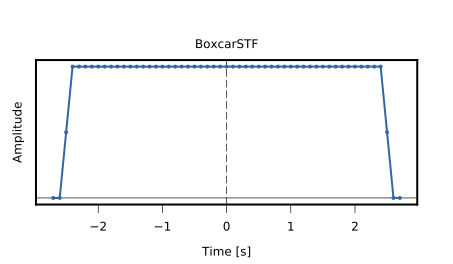
BoxcarSTF(effective_duration=None, **kwargs)[source]¶ Bases:
pyrocko.gf.seismosizer.STFBoxcar type source time function.
-
♦
duration¶ float, default:0.0duration of the boxcar
-
♦
anchor¶ float, default:0.0anchor point with respect to source.time: (-1.0: left -> source duration [0, T] ~ hypocenter time, 0.0: center -> source duration [-T/2, T/2] ~ centroid time, +1.0: right -> source duration [-T, 0] ~ rupture end time)
-
♦
-
class
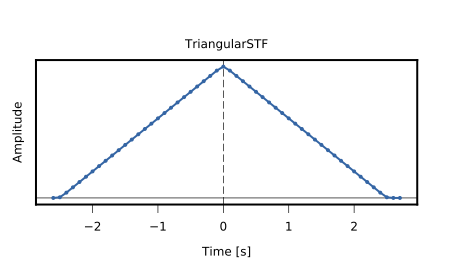
TriangularSTF(effective_duration=None, **kwargs)[source]¶ Bases:
pyrocko.gf.seismosizer.STFTriangular type source time function.
-
♦
duration¶ float, default:0.0baseline of the triangle
-
♦
peak_ratio¶ float, default:0.5fraction of time compared to duration, when the maximum amplitude is reached
-
♦
anchor¶ float, default:0.0anchor point with respect to source.time: (-1.0: left -> source duration [0, T] ~ hypocenter time, 0.0: center -> source duration [-T/2, T/2] ~ centroid time, +1.0: right -> source duration [-T, 0] ~ rupture end time)
-
♦
-
class
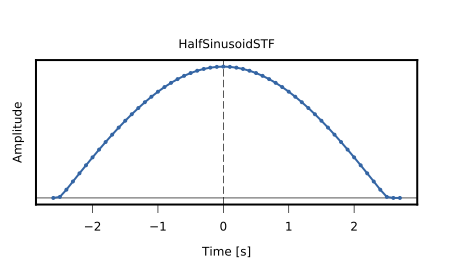
HalfSinusoidSTF(effective_duration=None, **kwargs)[source]¶ Bases:
pyrocko.gf.seismosizer.STFHalf sinusoid type source time function.
-
♦
duration¶ float, default:0.0duration of the half-sinusoid (baseline)
-
♦
anchor¶ float, default:0.0anchor point with respect to source.time: (-1.0: left -> source duration [0, T] ~ hypocenter time, 0.0: center -> source duration [-T/2, T/2] ~ centroid time, +1.0: right -> source duration [-T, 0] ~ rupture end time)
-
♦
exponent¶ int, default:1set to 2 to use square of the half-period sinusoidal function.
-
♦
-
class
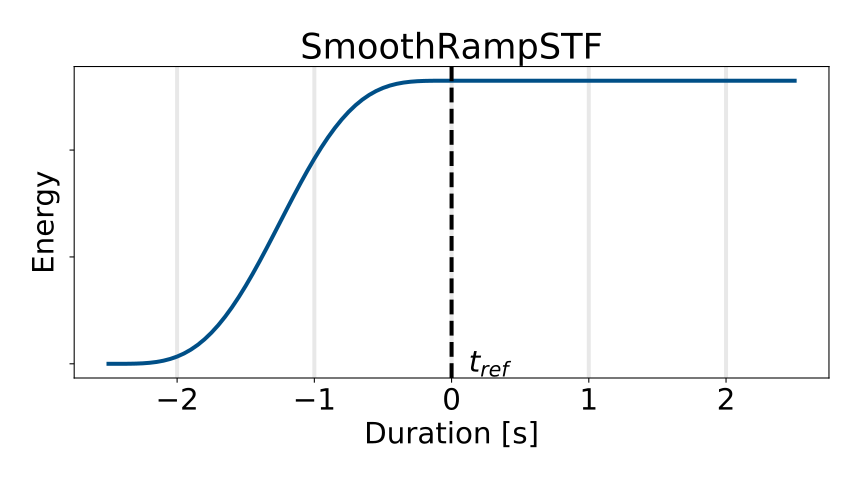
ResonatorSTF(effective_duration=None, **kwargs)[source]¶ Bases:
pyrocko.gf.seismosizer.STFSimple resonator like source time function.

-
♦
duration¶ float, default:0.0decay time
-
♦
frequency¶ float, default:1.0resonance frequency
-
♦
-
class
STFMode(dummy) → str[source]¶ Bases:
pyrocko.guts.StringChoiceAny
strout of['pre', 'post'].
-
class
Source(**kwargs)[source]¶ Bases:
pyrocko.model.location.Location,pyrocko.gf.seismosizer.CloneableBase class for all source models.
-
♦
name¶ str, optional, default:''
-
♦
time¶ builtins.float(pyrocko.guts.Timestamp), default:0.0source origin time.
-
♦
stf_mode¶ builtins.str(STFMode), default:'post'whether to apply source time function in pre or post-processing.
-
update(**kwargs)[source]¶ Change some of the source models parameters.
Example:
>>> from pyrocko import gf
>>> s = gf.DCSource()
>>> s.update(strike=66., dip=33.)
>>> print(s)
--- !pf.DCSource
depth: 0.0
time: 1970-01-01 00:00:00
magnitude: 6.0
strike: 66.0
dip: 33.0
rake: 0.0
-
grid(**variables)[source]¶ Create grid of source model variations.
Returns: SourceGridinstance.Example:
>>> from pyrocko import gf
>>> base = DCSource()
>>> R = gf.Range
>>> for s in base.grid(R('
-
base_key()[source]¶ Get key to decide about source discretization / GF stack sharing.
When two source models differ only in amplitude and origin time, the discretization and the GF stacking can be done only once for a unit amplitude and a zero origin time and the amplitude and origin times of the seismograms can be applied during post-processing of the synthetic seismogram.
For any derived parameterized source model, this method is called to decide if discretization and stacking of the source should be shared. When two source models return an equal vector of values discretization is shared.
-
get_factor()[source]¶ Get the scaling factor to be applied during post-processing.
Discretization of the base seismogram is usually done for a unit amplitude, because a common factor can be efficiently multiplied to final seismograms. This eliminates to do repeat the stacking when creating seismograms for a series of source models only differing in amplitude.
This method should return the scaling factor to apply in the post-processing (often this is simply the scalar moment of the source).
-
effective_stf_pre()[source]¶ Return the STF applied before stacking of the Green’s functions.
This STF is used during discretization of the parameterized source models, i.e. to produce a temporal distribution of point sources.
Handling of the STF before stacking of the GFs is less efficient but allows to use different source time functions for different parts of the source.
-
effective_stf_post()[source]¶ Return the STF applied after stacking of the Green’s fuctions.
This STF is used in the post-processing of the synthetic seismograms.
Handling of the STF after stacking of the GFs is usually more efficient but is only possible when a common STF is used for all subsources.
-
♦
-
class
SourceWithMagnitude(**kwargs)[source]¶ Bases:
pyrocko.gf.seismosizer.SourceBase class for sources containing a moment magnitude.
-
♦
magnitude¶ float, default:6.0Moment magnitude Mw as in [Hanks and Kanamori, 1979]
-
♦
-
class
SourceWithDerivedMagnitude(**kwargs)[source]¶ Bases:
pyrocko.gf.seismosizer.SourceUndocumented.
-
check_conflicts()[source]¶ Check for parameter conflicts.
To be overloaded in subclasses. Raises
DerivedMagnitudeErroron conflicts.
-
-
class
ExplosionSource(**kwargs)[source]¶ Bases:
pyrocko.gf.seismosizer.SourceWithDerivedMagnitudeAn isotropic explosion point source.
-
♦
magnitude¶ float, optionalmoment magnitude Mw as in [Hanks and Kanamori, 1979]
-
♦
volume_change¶ float, optionalvolume change of the explosion/implosion or the contracting/extending magmatic source. [m^3]
-
discretized_source_class
-
base_key()[source]¶ Get key to decide about source discretization / GF stack sharing.
When two source models differ only in amplitude and origin time, the discretization and the GF stacking can be done only once for a unit amplitude and a zero origin time and the amplitude and origin times of the seismograms can be applied during post-processing of the synthetic seismogram.
For any derived parameterized source model, this method is called to decide if discretization and stacking of the source should be shared. When two source models return an equal vector of values discretization is shared.
-
check_conflicts()[source]¶ Check for parameter conflicts.
To be overloaded in subclasses. Raises
DerivedMagnitudeErroron conflicts.
-
get_factor()[source]¶ Get the scaling factor to be applied during post-processing.
Discretization of the base seismogram is usually done for a unit amplitude, because a common factor can be efficiently multiplied to final seismograms. This eliminates to do repeat the stacking when creating seismograms for a series of source models only differing in amplitude.
This method should return the scaling factor to apply in the post-processing (often this is simply the scalar moment of the source).
-
♦
-
class
RectangularExplosionSource(**kwargs)[source]¶ Bases:
pyrocko.gf.seismosizer.ExplosionSourceRectangular or line explosion source.
-
♦
strike¶ float, default:0.0strike direction in [deg], measured clockwise from north
-
♦
dip¶ float, default:90.0dip angle in [deg], measured downward from horizontal
-
♦
length¶ float, default:0.0length of rectangular source area [m]
-
♦
width¶ float, default:0.0width of rectangular source area [m]
-
♦
anchor¶ builtins.str(pyrocko.guts.StringChoice), optional, default:'center'Anchor point for positioning the plane, can be: top, center orbottom and also top_left, top_right,bottom_left,bottom_right, center_left and center right
-
♦
nucleation_x¶ float, optionalhorizontal position of rupture nucleation in normalized fault plane coordinates (-1 = left edge, +1 = right edge)
-
♦
nucleation_y¶ float, optionaldown-dip position of rupture nucleation in normalized fault plane coordinates (-1 = upper edge, +1 = lower edge)
-
♦
velocity¶ float, default:3500.0speed of explosion front [m/s]
-
♦
aggressive_oversampling¶ bool, default:FalseAggressive oversampling for basesource discretization. When using ‘multilinear’ interpolation oversampling has practically no effect.
-
discretized_source_class
-
base_key()[source]¶ Get key to decide about source discretization / GF stack sharing.
When two source models differ only in amplitude and origin time, the discretization and the GF stacking can be done only once for a unit amplitude and a zero origin time and the amplitude and origin times of the seismograms can be applied during post-processing of the synthetic seismogram.
For any derived parameterized source model, this method is called to decide if discretization and stacking of the source should be shared. When two source models return an equal vector of values discretization is shared.
-
♦
-
class
DCSource(**kwargs)[source]¶ Bases:
pyrocko.gf.seismosizer.SourceWithMagnitudeA double-couple point source.
-
♦
strike¶ float, default:0.0strike direction in [deg], measured clockwise from north
-
♦
dip¶ float, default:90.0dip angle in [deg], measured downward from horizontal
-
♦
rake¶ float, default:0.0rake angle in [deg], measured counter-clockwise from right-horizontal in on-plane view
-
discretized_source_class¶ alias of
pyrocko.gf.meta.DiscretizedMTSource
-
base_key()[source]¶ Get key to decide about source discretization / GF stack sharing.
When two source models differ only in amplitude and origin time, the discretization and the GF stacking can be done only once for a unit amplitude and a zero origin time and the amplitude and origin times of the seismograms can be applied during post-processing of the synthetic seismogram.
For any derived parameterized source model, this method is called to decide if discretization and stacking of the source should be shared. When two source models return an equal vector of values discretization is shared.
-
get_factor()[source]¶ Get the scaling factor to be applied during post-processing.
Discretization of the base seismogram is usually done for a unit amplitude, because a common factor can be efficiently multiplied to final seismograms. This eliminates to do repeat the stacking when creating seismograms for a series of source models only differing in amplitude.
This method should return the scaling factor to apply in the post-processing (often this is simply the scalar moment of the source).
-
♦
-
class
CLVDSource(**kwargs)[source]¶ Bases:
pyrocko.gf.seismosizer.SourceWithMagnitudeA pure CLVD point source.
-
♦
azimuth¶ float, default:0.0azimuth direction of largest dipole, clockwise from north [deg]
-
♦
dip¶ float, default:90.0dip direction of largest dipole, downward from horizontal [deg]
-
discretized_source_class¶ alias of
pyrocko.gf.meta.DiscretizedMTSource
-
base_key()[source]¶ Get key to decide about source discretization / GF stack sharing.
When two source models differ only in amplitude and origin time, the discretization and the GF stacking can be done only once for a unit amplitude and a zero origin time and the amplitude and origin times of the seismograms can be applied during post-processing of the synthetic seismogram.
For any derived parameterized source model, this method is called to decide if discretization and stacking of the source should be shared. When two source models return an equal vector of values discretization is shared.
-
get_factor()[source]¶ Get the scaling factor to be applied during post-processing.
Discretization of the base seismogram is usually done for a unit amplitude, because a common factor can be efficiently multiplied to final seismograms. This eliminates to do repeat the stacking when creating seismograms for a series of source models only differing in amplitude.
This method should return the scaling factor to apply in the post-processing (often this is simply the scalar moment of the source).
-
♦
-
class
VLVDSource(**kwargs)[source]¶ Bases:
pyrocko.gf.seismosizer.SourceWithDerivedMagnitudeVolumetric linear vector dipole source.
This source is a parameterization for a restricted moment tensor point source, useful to represent dyke or sill like inflation or deflation sources. The restriction is such that the moment tensor is rotational symmetric. It can be represented by a superposition of a linear vector dipole (here we use a CLVD for convenience) and an isotropic component. The restricted moment tensor has 4 degrees of freedom: 2 independent eigenvalues and 2 rotation angles orienting the the symmetry axis.
In this parameterization, the isotropic component is controlled by
volume_change. To define the moment tensor, it must be converted to the scalar moment of the the MT’s isotropic component. For the conversion, the shear modulus at the source’s position must be known. This value is extracted from the earth model defined in the GF store in use.The CLVD part by controlled by its scalar moment
 :
:
clvd_moment. The sign ofclvd_momentis used to switch between a positiv or negativ CLVD (the sign of the largest eigenvalue).-
♦
azimuth¶ float, default:0.0azimuth direction of symmetry axis, clockwise from north [deg].
-
♦
dip¶ float, default:90.0dip direction of symmetry axis, downward from horizontal [deg].
-
♦
volume_change¶ float, default:0.0volume change of the inflation/deflation [m^3].
-
♦
clvd_moment¶ float, default:0.0scalar moment
of the CLVD component [Nm]. The sign controls the sign of the CLVD (the sign of its largest eigenvalue).
-
discretized_source_class¶ alias of
pyrocko.gf.meta.DiscretizedMTSource
-
base_key()[source]¶ Get key to decide about source discretization / GF stack sharing.
When two source models differ only in amplitude and origin time, the discretization and the GF stacking can be done only once for a unit amplitude and a zero origin time and the amplitude and origin times of the seismograms can be applied during post-processing of the synthetic seismogram.
For any derived parameterized source model, this method is called to decide if discretization and stacking of the source should be shared. When two source models return an equal vector of values discretization is shared.
-
♦
-
class
MTSource(**kwargs)[source]¶ Bases:
pyrocko.gf.seismosizer.SourceA moment tensor point source.
-
♦
mnn¶ float, default:1.0north-north component of moment tensor in [Nm]
-
♦
mee¶ float, default:1.0east-east component of moment tensor in [Nm]
-
♦
mdd¶ float, default:1.0down-down component of moment tensor in [Nm]
-
♦
mne¶ float, default:0.0north-east component of moment tensor in [Nm]
-
♦
mnd¶ float, default:0.0north-down component of moment tensor in [Nm]
-
♦
med¶ float, default:0.0east-down component of moment tensor in [Nm]
-
discretized_source_class¶ alias of
pyrocko.gf.meta.DiscretizedMTSource
-
base_key()[source]¶ Get key to decide about source discretization / GF stack sharing.
When two source models differ only in amplitude and origin time, the discretization and the GF stacking can be done only once for a unit amplitude and a zero origin time and the amplitude and origin times of the seismograms can be applied during post-processing of the synthetic seismogram.
For any derived parameterized source model, this method is called to decide if discretization and stacking of the source should be shared. When two source models return an equal vector of values discretization is shared.
-
♦
-
class
RectangularSource(**kwargs)[source]¶ Bases:
pyrocko.gf.seismosizer.SourceWithDerivedMagnitudeClassical Haskell source model modified for bilateral rupture.
-
♦
magnitude¶ float, optionalmoment magnitude Mw as in [Hanks and Kanamori, 1979]
-
♦
strike¶ float, default:0.0strike direction in [deg], measured clockwise from north
-
♦
dip¶ float, default:90.0dip angle in [deg], measured downward from horizontal
-
♦
rake¶ float, default:0.0rake angle in [deg], measured counter-clockwise from right-horizontal in on-plane view
-
♦
length¶ float, default:0.0length of rectangular source area [m]
-
♦
width¶ float, default:0.0width of rectangular source area [m]
-
♦
anchor¶ builtins.str(pyrocko.guts.StringChoice), optional, default:'center'Anchor point for positioning the plane, can be:
top, center bottom, top_left, top_right,bottom_left,bottom_right, center_left, center right.
-
♦
nucleation_x¶ float, optionalhorizontal position of rupture nucleation in normalized fault plane coordinates (
-1.= left edge,+1.= right edge)
-
♦
nucleation_y¶ float, optionaldown-dip position of rupture nucleation in normalized fault plane coordinates (
-1.= upper edge,+1.= lower edge)
-
♦
velocity¶ float, default:3500.0speed of rupture front [m/s]
-
♦
slip¶ float, optionalSlip on the rectangular source area [m]
-
♦
decimation_factor¶ int, optional, default:1Sub-source decimation factor, a larger decimation will make the result inaccurate but shorten the necessary computation time (use for testing puposes only).
-
♦
aggressive_oversampling¶ bool, default:FalseAggressive oversampling for basesource discretization. When using ‘multilinear’ interpolation oversampling has practically no effect.
-
discretized_source_class¶ alias of
pyrocko.gf.meta.DiscretizedMTSource
-
base_key()[source]¶ Get key to decide about source discretization / GF stack sharing.
When two source models differ only in amplitude and origin time, the discretization and the GF stacking can be done only once for a unit amplitude and a zero origin time and the amplitude and origin times of the seismograms can be applied during post-processing of the synthetic seismogram.
For any derived parameterized source model, this method is called to decide if discretization and stacking of the source should be shared. When two source models return an equal vector of values discretization is shared.
-
check_conflicts()[source]¶ Check for parameter conflicts.
To be overloaded in subclasses. Raises
DerivedMagnitudeErroron conflicts.
-
get_factor()[source]¶ Get the scaling factor to be applied during post-processing.
Discretization of the base seismogram is usually done for a unit amplitude, because a common factor can be efficiently multiplied to final seismograms. This eliminates to do repeat the stacking when creating seismograms for a series of source models only differing in amplitude.
This method should return the scaling factor to apply in the post-processing (often this is simply the scalar moment of the source).
-
♦
-
class
PseudoDynamicRupture(**kwargs)[source]¶ Bases:
pyrocko.gf.seismosizer.SourceWithDerivedMagnitudeMerged Eikonal and Okada Source for quasi-dynamic rupture modeling.
Details are described in Pseudo Dynamic Rupture - A stress-based self-similar finite source model.
-
♦
strike¶ float, default:0.0strike direction in [deg], measured clockwise from north
-
♦
dip¶ float, default:0.0dip angle in [deg], measured downward from horizontal
-
♦
length¶ float, default:10000.0length of rectangular source area [m]
-
♦
width¶ float, default:5000.0width of rectangular source area [m]
-
♦
anchor¶ builtins.str(pyrocko.guts.StringChoice), optional, default:'center'Anchor point for positioning the plane, can be:
top, center, bottom, top_left, top_right,bottom_left, bottom_right, center_left, center right
-
♦
nucleation_x¶ numpy.ndarray(pyrocko.guts_array.Array), default:array([0.])horizontal position of rupture nucleation in normalized fault plane coordinates (
-1.= left edge,+1.= right edge)
-
♦
nucleation_y¶ numpy.ndarray(pyrocko.guts_array.Array), default:array([0.])down-dip position of rupture nucleation in normalized fault plane coordinates (
-1.= upper edge,+1.= lower edge)
-
♦
nucleation_time¶ numpy.ndarray(pyrocko.guts_array.Array), optionalTime in [s] after origin, when nucleation points defined by
nucleation_xandnucleation_yrupture.
-
♦
gamma¶ float, default:0.8scaling factor between S wave velocity and rupture velocity:

-
♦
nx¶ int, default:2number of discrete source patches in x direction (along strike)
-
♦
ny¶ int, default:2number of discrete source patches in y direction (down dip)
-
♦
magnitude¶ float, optionalmoment magnitude Mw as in [Hanks and Kanamori, 1979]. Setting the moment magnitude the tractions/stress field will be normalized to accomodate the desired moment magnitude. Mutually exclusive with the slip parameter.
-
♦
slip¶ float, optionalmaximum slip of the rectangular source [m]. Setting the moment magnitude the tractions/stress field will be normalized to accomodate the desired maximum slip. Mutually exclusive with the magnitude parameter.
-
♦
rake¶ float, optionalrake angle in [deg], measured counter-clockwise from right-horizontal in on-plane view. Rake is translated into homogenous tractions in strike and up-dip direction.
rakeis mutually exclusive with tractions parameter.
-
♦
patches¶ listofpyrocko.modelling.okada.OkadaSourceobjects, optionalList of all boundary elements/sub faults/fault patches
-
♦
tractions¶ pyrocko.gf.tractions.TractionField, optionalTraction field the rupture plane is exposed to. See the:py:mod:pyrocko.gf.tractions module for more details. If
tractions=Noneandrakeis givenDirectedTractionswill be used.
-
♦
coef_mat¶ numpy.ndarray(pyrocko.guts_array.Array), optionalCoefficient matrix linking traction and dislocation field
-
♦
eikonal_decimation¶ int, optional, default:1Sub-source eikonal factor, a smaller eikonal factor will increase the accuracy of rupture front calculation but increases also the computation time.
-
♦
decimation_factor¶ int, optional, default:1Sub-source decimation factor, a larger decimation will make the result inaccurate but shorten the necessary computation time (use for testing puposes only).
-
♦
nthreads¶ int, optional, default:1Number of threads for Okada forward modelling, matrix inversion and calculation of point subsources. Note: for small/medium matrices 1 thread is most efficient!
-
♦
pure_shear¶ bool, optional, default:FalseCalculate only shear tractions and omit tensile tractions.
-
♦
smooth_rupture¶ bool, default:TrueSmooth the tractions by weighting partially ruptured fault patches.
-
♦
aggressive_oversampling¶ bool, default:FalseAggressive oversampling for basesource discretization. When using ‘multilinear’ interpolation oversampling has practically no effect.
-
discretized_source_class¶ alias of
pyrocko.gf.meta.DiscretizedMTSource
-
base_key()[source]¶ Get key to decide about source discretization / GF stack sharing.
When two source models differ only in amplitude and origin time, the discretization and the GF stacking can be done only once for a unit amplitude and a zero origin time and the amplitude and origin times of the seismograms can be applied during post-processing of the synthetic seismogram.
For any derived parameterized source model, this method is called to decide if discretization and stacking of the source should be shared. When two source models return an equal vector of values discretization is shared.
-
check_conflicts()[source]¶ Check for parameter conflicts.
To be overloaded in subclasses. Raises
DerivedMagnitudeErroron conflicts.
-
get_factor()[source]¶ Get the scaling factor to be applied during post-processing.
Discretization of the base seismogram is usually done for a unit amplitude, because a common factor can be efficiently multiplied to final seismograms. This eliminates to do repeat the stacking when creating seismograms for a series of source models only differing in amplitude.
This method should return the scaling factor to apply in the post-processing (often this is simply the scalar moment of the source).
-
discretize_time(store, interpolation='nearest_neighbor', vr=None, times=None, *args, **kwargs)[source]¶ Get rupture start time for discrete points on source plane
Parameters: - store (
pyrocko.gf.store.Store) – Greens function database (needs to cover whole region of of the source) - target (optional,
pyrocko.gf.targets.Target) – Target information - vr (optional,
numpy.ndarray) – Array, containing rupture user defined rupture velocity values - times (optional,
numpy.ndarray) – Array, containing zeros, where rupture is starting and otherwise -1, where time will be calculated. If not given, rupture starts at nucleation_x, nucleation_y. Times are given for discrete points with equal horizontal and vertical spacing
Returns: Coordinates (latlondepth), Coordinates (xy), rupture velocity rupture propagation time of discrete points
Return type: numpy.ndarray,(points.shape[0], 1),numpy.ndarray,(points.shape[0], 1),numpy.ndarray,(n_points_dip, n_points_strike),numpy.ndarray,(n_points_dip, n_points_strike)- store (
-
discretize_patches(store=None, interpolation='nearest_neighbor', grid_shape=(), *args, **kwargs)[source]¶ Get rupture start time and OkadaSource elements for discrete centre points on source plane and stores them in the patches-attribute
Arguments and keyword arguments needed for self.discretize_time.
Parameters: - store (
pyrocko.gf.store.Store) – Greens function database (needs to cover whole region of of the source) - interpolation (optional, str) – Kind of interpolation used. Choice between ‘multilinear’ and ‘nearest_neighbor’
- grid_shape (optional, tuple of int) – Desired sub fault patch grid size (nlength, nwidth). Either factor or grid_shape should be set.
- store (
-
discretize_basesource(store, target=None)[source]¶ Prepare source for synthetic waveform calculation
Parameters: store ( pyrocko.gf.store.Store) – Greens function database (needs to cover whole region of of the source)Returns: Source discretized by a set of moment tensors and times Return type: pyrocko.gf.meta.DiscretizedMTSource
-
calc_coef_mat()[source]¶ Calculate linear coefficient relating tractions and dislocations on the fault patches
-
get_patch_attribute(attr)[source]¶ Get array of patch attributes
Parameters: attr (str) – Attribute of fault patches which shall be listed for all patches in an array (possible attributes: check :py:class`pyrocko.modelling.okada.OkadaSource`) Returns: Array of attribute values per fault patch Return type: :py:class`numpy.ndarray`
-
get_okada_slip(time=None, scale_slip=True, interpolation='nearest_neighbor', **kwargs)[source]¶ Get slip per subfault patch for given time after rupture start
Parameters: time (float > 0.) – time after origin [s], for which slip is computed Returns: inverted displacements (u_strike, u_dip , u_tensile) for each source patch. order: [ patch1 u_Strike, patch1 u_Dip, patch1 u_Tensile, patch2 u_Strike, …] Return type: numpy.ndarray,(n_sources * 3, 1)
-
get_delta_slip(store=None, deltat=None, delta=True, interpolation='nearest_neighbor', **kwargs)[source]¶ Get slip change inverted from OkadaSources depending on store deltat
The time intervall, within which the slip changes are computed is determined by the sampling rate of the Greens function database. Arguments and keyword arguments needed for self.get_okada_slip.
Parameters: - store (optional,
pyrocko.gf.store.Store) – Greens function database (needs to cover whole region of of the source). Its delta t [s] is used as time increment for slip difference calculation. Either dt or store should be given. - deltat (optional, float) – time increment for slip difference calculation [s]. Either deltat or store should be given.
Returns: displacement changes(du_strike, du_dip , du_tensile) for each source patch and time. order: [ patch1 du_Strike t1, patch1 du_Dip t1, patch1 du_Tensile t1, patch2 du_Strike t1, …], [ patch1 du_Strike t2, patch1 du_Dip t2, patch1 du_Tensile t2, patch2 du_Strike t2, …]; corner times, for which delta slip is computed
Return type: numpy.ndarray,(n_sources, n_times, 3)numpy.ndarray,(n_times, 1)- store (optional,
-
get_moment_rate_patches(*args, **kwargs)[source]¶ Get scalar seismic moment rate for each boundary element individually
Arguments and keyword arguments needed for self.get_okada_slip.
Returns: seismic moment rate for each source patch and time. order: [ patch1 moment_rate t1, patch2 moment_rate t1, …], [ patch1 moment_rate t2, patch2 moment_rate t2, …]; corner times, for which moment rate is computed based on slip rate Return type: numpy.ndarray,(n_sources, n_times)numpy.ndarray,(n_times, 1)
-
get_moment_rate(store, deltat=None)[source]¶ Get seismic source moment rate for the total source (STF)
Parameters: - store (optional,
pyrocko.gf.store.Store) – Greens function database (needs to cover whole region of of the source). Its delta t [s] is used as time increment for slip difference calculation. Either dt or store should be given. - deltat (optional, float) – time increment for slip difference calculation [s]. Either deltat or store should be given.
Returns: seismic moment rate for each time. order: [ moment_rate t1, moment_rate t2, …]; corner times, for which moment rate is computed based on slip rate
Return type: numpy.ndarray,(n_times, 1)numpy.ndarray,(n_times, 1)- store (optional,
-
♦
-
class
DoubleDCSource(**kwargs)[source]¶ Bases:
pyrocko.gf.seismosizer.SourceWithMagnitudeTwo double-couple point sources separated in space and time. Moment share between the sub-sources is controlled by the parameter mix. The position of the subsources is dependent on the moment distribution between the two sources. Depth, east and north shift are given for the centroid between the two double-couples. The subsources will positioned according to their moment shares around this centroid position. This is done according to their delta parameters, which are therefore in relation to that centroid. Note that depth of the subsources therefore can be depth+/-delta_depth. For shallow earthquakes therefore the depth has to be chosen deeper to avoid sampling above surface.
-
♦
strike1¶ float, default:0.0strike direction in [deg], measured clockwise from north
-
♦
dip1¶ float, default:90.0dip angle in [deg], measured downward from horizontal
-
♦
azimuth¶ float, default:0.0azimuth to second double-couple [deg], measured at first, clockwise from north
-
♦
rake1¶ float, default:0.0rake angle in [deg], measured counter-clockwise from right-horizontal in on-plane view
-
♦
strike2¶ float, default:0.0strike direction in [deg], measured clockwise from north
-
♦
dip2¶ float, default:90.0dip angle in [deg], measured downward from horizontal
-
♦
rake2¶ float, default:0.0rake angle in [deg], measured counter-clockwise from right-horizontal in on-plane view
-
♦
delta_time¶ float, default:0.0separation of double-couples in time (t2-t1) [s]
-
♦
delta_depth¶ float, default:0.0difference in depth (z2-z1) [m]
-
♦
distance¶ float, default:0.0distance between the two double-couples [m]
-
♦
mix¶ float, default:0.5how to distribute the moment to the two doublecouples mix=0 -> m1=1 and m2=0; mix=1 -> m1=0, m2=1
-
♦
stf1¶ STF, optionalSource time function of subsource 1 (if given, overrides STF from attribute
Source.stf)
-
♦
stf2¶ STF, optionalSource time function of subsource 2 (if given, overrides STF from attribute
Source.stf)
-
discretized_source_class¶ alias of
pyrocko.gf.meta.DiscretizedMTSource
-
base_key()[source]¶ Get key to decide about source discretization / GF stack sharing.
When two source models differ only in amplitude and origin time, the discretization and the GF stacking can be done only once for a unit amplitude and a zero origin time and the amplitude and origin times of the seismograms can be applied during post-processing of the synthetic seismogram.
For any derived parameterized source model, this method is called to decide if discretization and stacking of the source should be shared. When two source models return an equal vector of values discretization is shared.
-
get_factor()[source]¶ Get the scaling factor to be applied during post-processing.
Discretization of the base seismogram is usually done for a unit amplitude, because a common factor can be efficiently multiplied to final seismograms. This eliminates to do repeat the stacking when creating seismograms for a series of source models only differing in amplitude.
This method should return the scaling factor to apply in the post-processing (often this is simply the scalar moment of the source).
-
effective_stf_post()[source]¶ Return the STF applied after stacking of the Green’s fuctions.
This STF is used in the post-processing of the synthetic seismograms.
Handling of the STF after stacking of the GFs is usually more efficient but is only possible when a common STF is used for all subsources.
-
♦
-
class
RingfaultSource(**kwargs)[source]¶ Bases:
pyrocko.gf.seismosizer.SourceWithMagnitudeA ring fault with vertical doublecouples.
-
♦
diameter¶ float, default:1.0diameter of the ring in [m]
-
♦
sign¶ float, default:1.0inside of the ring moves up (+1) or down (-1)
-
♦
strike¶ float, default:0.0strike direction of the ring plane, clockwise from north, in [deg]
-
♦
dip¶ float, default:0.0dip angle of the ring plane from horizontal in [deg]
-
♦
npointsources¶ int, default:360number of point sources to use
-
discretized_source_class¶ alias of
pyrocko.gf.meta.DiscretizedMTSource
-
base_key()[source]¶ Get key to decide about source discretization / GF stack sharing.
When two source models differ only in amplitude and origin time, the discretization and the GF stacking can be done only once for a unit amplitude and a zero origin time and the amplitude and origin times of the seismograms can be applied during post-processing of the synthetic seismogram.
For any derived parameterized source model, this method is called to decide if discretization and stacking of the source should be shared. When two source models return an equal vector of values discretization is shared.
-
get_factor()[source]¶ Get the scaling factor to be applied during post-processing.
Discretization of the base seismogram is usually done for a unit amplitude, because a common factor can be efficiently multiplied to final seismograms. This eliminates to do repeat the stacking when creating seismograms for a series of source models only differing in amplitude.
This method should return the scaling factor to apply in the post-processing (often this is simply the scalar moment of the source).
-
♦
-
class
CombiSource(subsources=[], **kwargs)[source]¶ Bases:
pyrocko.gf.seismosizer.SourceComposite source model.
-
discretized_source_class¶ alias of
pyrocko.gf.meta.DiscretizedMTSource
-
get_factor()[source]¶ Get the scaling factor to be applied during post-processing.
Discretization of the base seismogram is usually done for a unit amplitude, because a common factor can be efficiently multiplied to final seismograms. This eliminates to do repeat the stacking when creating seismograms for a series of source models only differing in amplitude.
This method should return the scaling factor to apply in the post-processing (often this is simply the scalar moment of the source).
-
-
class
SFSource(**kwargs)[source]¶ Bases:
pyrocko.gf.seismosizer.SourceA single force point source.
-
♦
fn¶ float, default:0.0northward component of single force [N]
-
♦
fe¶ float, default:0.0eastward component of single force [N]
-
♦
fd¶ float, default:0.0downward component of single force [N]
-
discretized_source_class¶ alias of
pyrocko.gf.meta.DiscretizedSFSource
-
base_key()[source]¶ Get key to decide about source discretization / GF stack sharing.
When two source models differ only in amplitude and origin time, the discretization and the GF stacking can be done only once for a unit amplitude and a zero origin time and the amplitude and origin times of the seismograms can be applied during post-processing of the synthetic seismogram.
For any derived parameterized source model, this method is called to decide if discretization and stacking of the source should be shared. When two source models return an equal vector of values discretization is shared.
-
get_factor()[source]¶ Get the scaling factor to be applied during post-processing.
Discretization of the base seismogram is usually done for a unit amplitude, because a common factor can be efficiently multiplied to final seismograms. This eliminates to do repeat the stacking when creating seismograms for a series of source models only differing in amplitude.
This method should return the scaling factor to apply in the post-processing (often this is simply the scalar moment of the source).
-
♦
-
class
PorePressurePointSource(**kwargs)[source]¶ Bases:
pyrocko.gf.seismosizer.SourceExcess pore pressure point source.
For poro-elastic initial value problem where an excess pore pressure is brought into a small source volume.
-
♦
pp¶ float, default:1.0initial excess pore pressure in [Pa]
-
discretized_source_class
-
base_key()[source]¶ Get key to decide about source discretization / GF stack sharing.
When two source models differ only in amplitude and origin time, the discretization and the GF stacking can be done only once for a unit amplitude and a zero origin time and the amplitude and origin times of the seismograms can be applied during post-processing of the synthetic seismogram.
For any derived parameterized source model, this method is called to decide if discretization and stacking of the source should be shared. When two source models return an equal vector of values discretization is shared.
-
get_factor()[source]¶ Get the scaling factor to be applied during post-processing.
Discretization of the base seismogram is usually done for a unit amplitude, because a common factor can be efficiently multiplied to final seismograms. This eliminates to do repeat the stacking when creating seismograms for a series of source models only differing in amplitude.
This method should return the scaling factor to apply in the post-processing (often this is simply the scalar moment of the source).
-
♦
-
class
PorePressureLineSource(**kwargs)[source]¶ Bases:
pyrocko.gf.seismosizer.SourceExcess pore pressure line source.
The line source is centered at (north_shift, east_shift, depth).
-
♦
pp¶ float, default:1.0initial excess pore pressure in [Pa]
-
♦
length¶ float, default:0.0length of the line source [m]
-
♦
azimuth¶ float, default:0.0azimuth direction, clockwise from north [deg]
-
♦
dip¶ float, default:90.0dip direction, downward from horizontal [deg]
-
discretized_source_class
-
base_key()[source]¶ Get key to decide about source discretization / GF stack sharing.
When two source models differ only in amplitude and origin time, the discretization and the GF stacking can be done only once for a unit amplitude and a zero origin time and the amplitude and origin times of the seismograms can be applied during post-processing of the synthetic seismogram.
For any derived parameterized source model, this method is called to decide if discretization and stacking of the source should be shared. When two source models return an equal vector of values discretization is shared.
-
get_factor()[source]¶ Get the scaling factor to be applied during post-processing.
Discretization of the base seismogram is usually done for a unit amplitude, because a common factor can be efficiently multiplied to final seismograms. This eliminates to do repeat the stacking when creating seismograms for a series of source models only differing in amplitude.
This method should return the scaling factor to apply in the post-processing (often this is simply the scalar moment of the source).
-
♦
-
class
Request(*args, **kwargs)[source]¶ Bases:
pyrocko.guts.ObjectSynthetic seismogram computation request.
Request(**kwargs)
Request(sources, targets, **kwargs)
-
♦
targets¶ listofpyrocko.gf.targets.Targetobjects, default:[]list of targets for which to produce synthetics.
-
♦
-
class
ProcessingStats(**kwargs)[source]¶ Bases:
pyrocko.guts.ObjectUndocumented.
-
♦
t_perc_get_store_and_receiver¶ float, default:0.0
-
♦
t_perc_discretize_source¶ float, default:0.0
-
♦
t_perc_make_base_seismogram¶ float, default:0.0
-
♦
t_perc_make_same_span¶ float, default:0.0
-
♦
t_perc_post_process¶ float, default:0.0
-
♦
t_perc_optimize¶ float, default:0.0
-
♦
t_perc_stack¶ float, default:0.0
-
♦
t_perc_static_get_store¶ float, default:0.0
-
♦
t_perc_static_discretize_basesource¶ float, default:0.0
-
♦
t_perc_static_sum_statics¶ float, default:0.0
-
♦
t_perc_static_post_process¶ float, default:0.0
-
♦
t_wallclock¶ float, default:0.0
-
♦
t_cpu¶ float, default:0.0
-
♦
n_read_blocks¶ int, default:0
-
♦
n_results¶ int, default:0
-
♦
n_subrequests¶ int, default:0
-
♦
n_stores¶ int, default:0
-
♦
n_records_stacked¶ int, default:0
-
♦
-
class
Response(**kwargs)[source]¶ Bases:
pyrocko.guts.ObjectResonse object to a synthetic seismogram computation request.
-
♦
results_list¶ listoflistofpyrocko.gf.meta.SeismosizerResultobjects objects, default:[]
-
♦
stats
-
static_results()[source]¶ Return a list of requested
StaticResultinstances.
-
♦
-
class
Engine(**kwargs)[source]¶ Bases:
pyrocko.guts.ObjectBase class for synthetic seismogram calculators.
-
class
LocalEngine(**kwargs)[source]¶ Bases:
pyrocko.gf.seismosizer.EngineOffline synthetic seismogram calculator.
Parameters: - use_env – if
True, fillstore_superdirsandstore_dirswith paths set in environment variables GF_STORE_SUPERDIRS and GF_STORE_DIRS. - use_config –
if
True, fillstore_superdirsandstore_dirswith paths set in the user’s config file.The config file can be found at
~/.pyrocko/config.pfgf_store_dirs: ['/home/pyrocko/gf_stores/ak135/'] gf_store_superdirs: ['/home/pyrocko/gf_stores/']
-
♦
store_superdirs¶ listofstrobjects, default:[]directories which are searched for Green’s function stores
-
♦
store_dirs¶ listofstrobjects, default:[]additional individual Green’s function store directories
-
♦
default_store_id¶ str, optionaldefault store ID to be used when a request does not provide one
-
get_store(store_id=None)[source]¶ Get a store from the engine.
Parameters: store_id – identifier of the store (optional) Returns: StoreobjectIf no
store_idis provided the store associated with thedefault_store_idis returned. RaisesNoDefaultStoreSetifdefault_store_idis undefined.
- use_env – if
-
class
RemoteEngine(**kwargs)[source]¶ Bases:
pyrocko.gf.seismosizer.EngineClient for remote synthetic seismogram calculator.
-
♦
site¶ str, optional, default:'localhost'
-
♦
url¶ str, optional, default:'%(site)s/gfws/%(service)s/%(majorversion)i/%(method)s'
-
♦
-
class
SourceList(**kwargs)[source]¶ Bases:
pyrocko.gf.seismosizer.SourceGroupUndocumented.
gf.targets
-
class
OptimizationMethod(dummy) → str[source]¶ Bases:
pyrocko.guts.StringChoiceAny
strout of['enable', 'disable'].
-
component_orientation(source, target, component)[source]¶ Get component and azimuth for standard components R, T, Z, N, and E.
Parameters: - source –
pyrocko.gf.Locationobject - target –
pyrocko.gf.Locationobject - component – string
'R','T','Z','N'or'E'
- source –
-
class
Target(**kwargs)[source]¶ Bases:
pyrocko.gf.meta.ReceiverA seismogram computation request for a single component, including its post-processing parmeters.
-
♦
quantity¶ builtins.str(pyrocko.gf.meta.QuantityType), optionalMeasurement quantity type. If not given, it is guessed from the channel code. For some common cases, derivatives of the stored quantities are supported by using finite difference approximations (e.g. displacement to velocity or acceleration). 4th order central FD schemes are used.
-
♦
codes¶ tupleof 4strobjects, default:('', 'STA', '', 'Z')network, station, location and channel codes to be set on the response trace.
-
♦
elevation¶ float, default:0.0station surface elevation in [m]
-
♦
store_id¶ builtins.str(pyrocko.gf.meta.StringID), optionalID of Green’s function store to use for the computation. If not given, the processor may use a system default.
-
♦
sample_rate¶ float, optionalsample rate to produce. If not given the GF store’s default sample rate is used. GF store specific restrictions may apply.
-
♦
interpolation¶ builtins.str(pyrocko.gf.meta.InterpolationMethod), default:'nearest_neighbor'Interpolation method between Green’s functions. Supported are
nearest_neighborandmultilinear
-
♦
optimization¶ builtins.str(OptimizationMethod), optional, default:'enable'disable/enable optimizations in weight-delay-and-sum operation
-
♦
tmin¶ builtins.float(pyrocko.guts.Timestamp), optionaltime of first sample to request in [s]. If not given, it is determined from the Green’s functions.
-
♦
tmax¶ builtins.float(pyrocko.guts.Timestamp), optionaltime of last sample to request in [s]. If not given, it is determined from the Green’s functions.
-
♦
azimuth¶ float, optionalazimuth of sensor component in [deg], clockwise from north. If not given, it is guessed from the channel code.
-
♦
dip¶ float, optionaldip of sensor component in [deg], measured downward from horizontal. If not given, it is guessed from the channel code.
-
♦
-
class
StaticTarget(*args, **kwargs)[source]¶ Bases:
pyrocko.gf.meta.MultiLocationA computation request for a spatial multi-location target of static/geodetic quantities.
-
♦
quantity¶ builtins.str(pyrocko.gf.meta.QuantityType), optional, default:'displacement'Measurement quantity type, for now only displacement issupported.
-
♦
interpolation¶ builtins.str(pyrocko.gf.meta.InterpolationMethod), default:'nearest_neighbor'Interpolation method between Green’s functions. Supported are
nearest_neighborandmultilinear
-
♦
tsnapshot¶ builtins.float(pyrocko.guts.Timestamp), optionaltime of the desired snapshot in [s], If not given, the first sample is taken. If the desired sample exceeds the length of the Green’s function store, the last sample is taken.
-
♦
store_id¶ builtins.str(pyrocko.gf.meta.StringID), optionalID of Green’s function store to use for the computation. If not given, the processor may use a system default.
-
ntargets¶ Number of targets held by instance.
-
♦
-
class
SatelliteTarget(*args, **kwargs)[source]¶ Bases:
pyrocko.gf.targets.StaticTargetA computation request for a spatial multi-location target of static/geodetic quantities measured from a satellite instrument. The line of sight angles are provided and projecting post-processing is applied.
-
♦
theta¶ numpy.ndarray(pyrocko.guts_array.Array)Horizontal angle towards satellite’s line of sight in radians.
Important
 is east and
  is north.
-
♦
phi¶ numpy.ndarray(pyrocko.guts_array.Array)Theta is look vector elevation angle towards satellite from horizon in radians. Matrix of theta towards satellite’s line of sight.
Important
 is down and is up.
-
♦
-
class
KiteSceneTarget(scene, **kwargs)[source]¶ Bases:
pyrocko.gf.targets.SatelliteTargetUndocumented.
-
♦
shape¶ tupleof 2intobjects, default:(None, None)Shape of the displacement vectors.
-
♦
-
class
GNSSCampaignTarget(*args, **kwargs)[source]¶ Bases:
pyrocko.gf.targets.StaticTargetUndocumented.
gf.tractions
-
class
AbstractTractionField(**kwargs)[source]¶ Bases:
pyrocko.guts.ObjectAbstract traction field
Fields of this type a re multiplied in the
TractionComposition
-
class
TractionField(**kwargs)[source]¶ Bases:
pyrocko.gf.tractions.AbstractTractionFieldTraction field
Fields of this type are added in the
TractionComposition
-
class
TractionComposition(**kwargs)[source]¶ Bases:
pyrocko.gf.tractions.TractionFieldComposition of traction fields
TractionFieldandAbstractTractionFieldcan be combined to realize a combination of different fields.-
♦
components¶ listofAbstractTractionFieldobjects, default:[]Ordered list of tractions
-
♦
-
class
UniformTractions(**kwargs)[source]¶ Bases:
pyrocko.gf.tractions.TractionFieldUniform traction field
The traction field is uniform in strike, dip and normal direction. This realisation is not only simple but also unrealistic.
-
♦
traction¶ float, default:1.0Uniform traction in strike, dip and normal direction [Pa]
-
♦
-
class
HomogeneousTractions(**kwargs)[source]¶ Bases:
pyrocko.gf.tractions.TractionFieldHomogeneous traction field
The traction vectors in strike, dip and normal direction are acting homogeneously on the rupture plane.
-
♦
strike¶ float, default:1.0Tractions in strike direction [Pa]
-
♦
dip¶ float, default:1.0Traction in dip direction (up) [Pa]
-
♦
normal¶ float, default:1.0Traction in normal direction [Pa]
-
♦
-
class
DirectedTractions(**kwargs)[source]¶ Bases:
pyrocko.gf.tractions.TractionFieldDirected traction field
The traction vectors are following a uniform
rake.-
♦
rake¶ float, default:0.0rake angle in [deg], measured counter-clockwise from right-horizontal in on-plane view. Rake is translated into homogenous tractions in strike and up-dip direction.
-
♦
traction¶ float, default:1.0Traction in rake direction [Pa]
-
♦
-
class
SelfSimilarTractions(**kwargs)[source]¶ Bases:
pyrocko.gf.tractions.TractionFieldTraction model following Power & Tullis (1991).
The traction vectors are calculated as a sum of 2D-cosines with a constant amplitude / wavelength ratio. The wavenumber kx and ky are constant for each cosine function. The rank defines the maximum wavenumber used for summation. So, e.g. a rank of 3 will lead to a summation of cosines with
kx = kyin (1, 2, 3). Each cosine has an associated phases, which defines both the phase shift and also the shift from the rupture plane centre. Finally the summed cosines are translated into shear tractions based on the rake and normalized withtraction_max.-
♦
rank¶ int, default:1maximum summed cosine wavenumber/spatial frequency.
-
♦
rake¶ float, default:0.0rake angle in [deg], measured counter-clockwise from right-horizontal in on-plane view. Rake is translated into homogenous tractions in strike and up-dip direction.
-
♦
traction_max¶ float, default:1.0maximum traction vector length [Pa]
-
♦
phases¶ numpy.ndarray(pyrocko.guts_array.Array), optionalphase shift of the cosines in [rad].
-
♦
-
class
FractalTractions(*args, **kwargs)[source]¶ Bases:
pyrocko.gf.tractions.TractionFieldFractal traction field
-
♦
rseed¶ int, optionalSeed for
RandomState.IfNone, an random seed will be initialized.
-
♦
rake¶ float, default:0.0rake angle in [deg], measured counter-clockwise from right-horizontal in on-plane view. Rake is translated into homogenous tractions in strike and up-dip direction.
-
♦
traction_max¶ float, default:1.0maximum traction vector length [Pa]
-
♦
-
class
RectangularTaper(**kwargs)[source]¶ Bases:
pyrocko.gf.tractions.AbstractTractionFieldUndocumented.
-
♦
width¶ float, default:0.2Width of the taper as a fraction of the plane.
-
♦
type¶ builtins.str(pyrocko.guts.StringChoice), default:'tukey'Type of the taper, default “tukey”
-
♦
-
class
DepthTaper(**kwargs)[source]¶ Bases:
pyrocko.gf.tractions.AbstractTractionFieldUndocumented.
-
♦
depth_start¶ floatDepth where the taper begins [km]
-
♦
depth_stop¶ floatDepth where taper stops, and drops to 0. [km]
-
♦
type¶ builtins.str(pyrocko.guts.StringChoice), default:'linear'Type of the taper, default “linear”
-
♦
-
plot_tractions(tractions, nx=15, ny=12, depth=10000.0, component='strike')[source]¶ Plot choosen traction model for quick inspection
Parameters: - tractions (
pyrocko.gf.tractions.TractionField) – traction field or traction composition to be displayed - nx (optional, int) – number of patches along strike
- ny (optional, int) – number of patches down dip
- depth (optional, float) – depth of the rupture plane center in [m]
- component (optional, str) – choice, which component of the traction is displayed. Choose between: - “tx”: along strike tractions - “ty”: up dip tractions - “tz”: normal tractions - “absolut”: length of the traction vector
- tractions (
gf.meta
-
class
InterpolationMethod(dummy) → str[source]¶ Bases:
pyrocko.guts.StringChoiceAny
strout of['nearest_neighbor', 'multilinear'].
-
class
SeismosizerTrace(**kwargs)[source]¶ Bases:
pyrocko.guts.ObjectUndocumented.
-
♦
codes¶ tupleof 4strobjects, default:('', 'STA', '', 'Z')network, station, location and channel codes
-
♦
data¶ numpy.ndarray(pyrocko.guts_array.Array)numpy array with data samples
-
♦
deltat¶ float, default:1.0sampling interval [s]
-
♦
tmin¶ builtins.float(pyrocko.guts.Timestamp), default:0.0time of first sample as a system timestamp [s]
-
♦
-
class
SeismosizerResult(**kwargs)[source]¶ Bases:
pyrocko.guts.ObjectUndocumented.
-
♦
n_records_stacked¶ int, optional, default:1
-
♦
t_stack¶ float, optional, default:0.0
-
♦
-
class
Result(**kwargs)[source]¶ Bases:
pyrocko.gf.meta.SeismosizerResultUndocumented.
-
♦
trace¶ SeismosizerTrace, optional
int, optional, default:1
-
♦
t_optimize¶ float, optional, default:0.0
-
♦
-
class
StaticResult(**kwargs)[source]¶ Bases:
pyrocko.gf.meta.SeismosizerResultUndocumented.
-
♦
result¶ dictofnumpy.ndarray(pyrocko.guts_array.Array) objects, default:{}
-
♦
-
class
ComponentScheme(dummy) → str[source]¶ Bases:
pyrocko.guts.StringChoiceDifferent Green’s Function component schemes are available:
Name Description elastic10Elastodynamic for ConfigTypeAandConfigTypeBstores, MT sources onlyelastic8Elastodynamic for far-field only ConfigTypeAandConfigTypeBstores, MT sources onlyelastic2Elastodynamic for ConfigTypeAandConfigTypeBstores, purely isotropic sources onlyelastic5Elastodynamic for ConfigTypeAandConfigTypeBstores, SF sources onlyelastic18Elastodynamic for ConfigTypeCstores, MT sources onlyporoelastic10Poroelastic for ConfigTypeAandConfigTypeBstores
-
class
StringID(dummy) → str[source]¶ Bases:
pyrocko.guts.StringPatternAny
strmatching pattern'^[A-Za-z][A-Za-z0-9._]{0,64}$'.
-
class
ScopeType(dummy) → str[source]¶ Bases:
pyrocko.guts.StringChoiceAny
strout of['global', 'regional', 'local'].
-
class
NearfieldTermsType(dummy) → str[source]¶ Bases:
pyrocko.guts.StringChoiceAny
strout of['complete', 'incomplete', 'missing'].
-
class
QuantityType(dummy) → str[source]¶ Bases:
pyrocko.guts.StringChoiceAny
strout of['displacement', 'rotation', 'velocity', 'acceleration', 'pressure', 'tilt', 'pore_pressure', 'darcy_velocity', 'vertical_tilt'].
-
class
Reference(**kwargs)[source]¶ Bases:
pyrocko.guts.ObjectUndocumented.
-
♦
type¶ str
-
♦
title¶ str
-
♦
journal¶ str, optional
-
♦
volume¶ str, optional
-
♦
number¶ str, optional
-
♦
pages¶ str, optional
-
♦
year¶ str
-
♦
issn¶ str, optional
-
♦
doi¶ str, optional
-
♦
url¶ str, optional
-
♦
eprint¶ str, optional
listofstrobjects, default:[]
-
♦
publisher¶ str, optional
-
♦
keywords¶ str, optional
-
♦
note¶ str, optional
-
♦
abstract¶ str, optional
-
♦
-
class
PhaseSelect(dummy) → str[source]¶ Bases:
pyrocko.guts.StringChoiceAny
strout of['', 'first', 'last'].
-
class
Timing(s=None, **kwargs)[source]¶ Bases:
pyrocko.guts.SObjectDefinition of a time instant relative to one or more named phase arrivals
Instances of this class can be used e.g. in cutting and tapering operations. They can hold an absolute time or an offset to a named phase arrival or group of such arrivals.
Timings can be instantiated from a simple string defintion i.e. with
Timing(str)wherestris something like'SELECT{PHASE_DEFS}[+-]OFFSET[S|%]'where'SELECT'is'first','last'or empty,'PHASE_DEFS'is a'|'-separated list of phase definitions, and'OFFSET'is the time offset in seconds. If a'%'is appended, it is interpreted as percent. If the an'S'is appended to'OFFSET', it is interpreted as a surface slowness in [s/km].Phase definitions can be specified in either of the following ways:
'stored:PHASE_ID'- retrieves value from stored travel time table'cake:CAKE_PHASE_DEF'- evaluates first arrival of phase with cake (seepyrocko.cake.PhaseDef)'vel_surface:VELOCITY'- arrival according to surface distance / velocity [km/s]'vel:VELOCITY'- arrival according to 3D-distance / velocity [km/s]
Examples:
'100': absolute time; 100 s'{stored:P}-100': 100 s before arrival of P phase according to stored travel time table named'P'*'{stored:P}-10%': 10% before arrival of P phase according to stored travel time table named'P''{stored:A|stored:B}': time instant of phase arrival A, or B if A is undefined for a given geometry'first{stored:A|stored:B}': as above, but the earlier arrival of A and B is chosen, if both phases are defined for a given geometry'last{stored:A|stored:B}': as above but the later arrival is chosen'first{stored:A|stored:B|stored:C}-100': 100 s before first out of arrivals A, B, and C
-
♦
phase_defs¶ listofstrobjects, default:[]
-
♦
offset¶ float, default:0.0
-
♦
offset_is_slowness¶ bool, default:False
-
♦
offset_is_percent¶ bool, default:False
-
♦
select¶ builtins.str(PhaseSelect), default:''Can be either
'','first', or'last'.
-
class
TPDef(**kwargs)[source]¶ Bases:
pyrocko.guts.ObjectMaps an arrival phase identifier to an arrival phase definition.
-
♦
definition¶ strdefinition of the phase in either cake syntax as defined in
pyrocko.cake.PhaseDef, or, if prepended with an!, as a classic phase name, or, if it is a simple number, as a constant horizontal velocity.
-
♦
-
class
Receiver(**kwargs)[source]¶ Bases:
pyrocko.model.location.LocationUndocumented.
-
♦
codes¶ tupleof 3strobjects, optionalnetwork, station, and location codes
-
♦
Bases:
Exception
-
class
DiscretizedExplosionSource(**kwargs)[source]¶ Bases:
pyrocko.gf.meta.DiscretizedSourceUndocumented.
-
♦
m0s¶ numpy.ndarray(pyrocko.guts_array.Array)
-
classmethod
combine(sources, **kwargs)[source]¶ Combine several discretized source models.
Concatenenates all point sources in the given discretized
sources. Care must be taken when using this function that the external amplitude factors and reference times of the parameterized (undiscretized) sources match or are accounted for.
-
♦
-
class
DiscretizedSFSource(**kwargs)[source]¶ Bases:
pyrocko.gf.meta.DiscretizedSourceUndocumented.
-
♦
forces¶ numpy.ndarray(pyrocko.guts_array.Array)
-
classmethod
combine(sources, **kwargs)[source]¶ Combine several discretized source models.
Concatenenates all point sources in the given discretized
sources. Care must be taken when using this function that the external amplitude factors and reference times of the parameterized (undiscretized) sources match or are accounted for.
-
♦
-
class
DiscretizedMTSource(**kwargs)[source]¶ Bases:
pyrocko.gf.meta.DiscretizedSourceUndocumented.
-
♦
m6s¶ numpy.ndarray(pyrocko.guts_array.Array)rows with (m_nn, m_ee, m_dd, m_ne, m_nd, m_ed)
-
classmethod
combine(sources, **kwargs)[source]¶ Combine several discretized source models.
Concatenenates all point sources in the given discretized
sources. Care must be taken when using this function that the external amplitude factors and reference times of the parameterized (undiscretized) sources match or are accounted for.
-
♦
-
class
DiscretizedPorePressureSource(**kwargs)[source]¶ Bases:
pyrocko.gf.meta.DiscretizedSourceUndocumented.
-
♦
pp¶ numpy.ndarray(pyrocko.guts_array.Array)
-
classmethod
combine(sources, **kwargs)[source]¶ Combine several discretized source models.
Concatenenates all point sources in the given discretized
sources. Care must be taken when using this function that the external amplitude factors and reference times of the parameterized (undiscretized) sources match or are accounted for.
-
♦
-
class
RectangularRegion(**kwargs)[source]¶ Bases:
pyrocko.gf.meta.RegionUndocumented.
-
♦
lat_min¶ float
-
♦
lat_max¶ float
-
♦
lon_min¶ float
-
♦
lon_max¶ float
-
♦
-
class
CircularRegion(**kwargs)[source]¶ Bases:
pyrocko.gf.meta.RegionUndocumented.
-
♦
lat¶ float
-
♦
lon¶ float
-
♦
radius¶ float
-
♦
-
class
Config(**kwargs)[source]¶ Bases:
pyrocko.guts.ObjectGreen’s function store meta information.
Currently implemented
Storeconfiguration types are:ConfigTypeA- cylindrical or spherical symmetry, 1D earth model, single receiver depth- Problem is invariant to horizontal translations and rotations around vertical axis.
- All receivers must be at the same depth (e.g. at the surface)
- High level index variables:
(source_depth, receiver_distance,
component)
ConfigTypeB- cylindrical or spherical symmetry, 1D earth model, variable receiver depth- Symmetries like in Type A but has additional index for receiver depth
- High level index variables:
(source_depth, receiver_distance,
receiver_depth, component)
ConfigTypeC- no symmetrical constraints but fixed receiver positions- Cartesian source volume around a reference point
- High level index variables:
(ireceiver, source_depth,
source_east_shift, source_north_shift, component)
-
♦
id¶ builtins.str(StringID)Name of the store. May consist of upper and lower-case letters, digits, dots and underscores. The name must start with a letter.
-
♦
derived_from_id¶ builtins.str(StringID), optionalName of the original store, if this store has been derived from another one (e.g. extracted subset).
-
♦
version¶ str, optional, default:'1.0'User-defined version string. Use <major>.<minor> format.
-
♦
modelling_code_id¶ builtins.str(StringID), optionalIdentifier of the backend used to compute the store.
str, optionalComma-separated list of author names.
str, optionalAuthor’s contact email address.
-
♦
created_time¶ builtins.float(pyrocko.guts.Timestamp), optionalTime of creation of the store.
-
♦
regions¶ listofRegionobjects, default:[]Geographical regions for which the store is representative.
-
♦
scope_type¶ builtins.str(ScopeType), optionalDistance range scope of the store (choices:
'global','regional','local').
-
♦
waveform_type¶ builtins.str(WaveType), optionalWave type stored (choices:
'full waveform','bodywave','P wave','S wave','surface wave').
-
♦
nearfield_terms¶ builtins.str(NearfieldTermsType), optionalInformation about the inclusion of near-field terms in the modelling (choices:
'complete','incomplete','missing').
-
♦
description¶ str, optionalFree form textual description of the GF store.
-
♦
references¶ listofReferenceobjects, default:[]Reference list to cite the modelling code, earth model or related work.
-
♦
earthmodel_1d¶ pyrocko.cake.LayeredModel(Earthmodel1D), optionalLayered earth model in ND (named discontinuity) format.
-
♦
earthmodel_receiver_1d¶ pyrocko.cake.LayeredModel(Earthmodel1D), optionalReceiver-side layered earth model in ND format.
-
♦
can_interpolate_source¶ bool, optionalHint to indicate if the spatial sampling of the store is dense enough for multi-linear interpolation at the source.
-
♦
can_interpolate_receiver¶ bool, optionalHint to indicate if the spatial sampling of the store is dense enough for multi-linear interpolation at the receiver.
-
♦
frequency_min¶ float, optionalHint to indicate the lower bound of valid frequencies [Hz].
-
♦
frequency_max¶ float, optionalHint to indicate the upper bound of valid frequencies [Hz].
-
♦
sample_rate¶ float, optionalSample rate of the GF store [Hz].
-
♦
factor¶ float, optional, default:1.0Gain value, factored out of the stored GF samples. (may not work properly, keep at 1.0).
-
♦
component_scheme¶ builtins.str(ComponentScheme), default:'elastic10'GF component scheme (choices:
'elastic2','elastic8','elastic10','elastic18','elastic5','poroelastic10').
-
♦
stored_quantity¶ builtins.str(QuantityType), optionalPhysical quantity of stored values (choices:
'displacement','rotation','velocity','acceleration','pressure','tilt','pore_pressure','darcy_velocity','vertical_tilt'). If not given, a default is used based on the GF component scheme. The default for the"elastic*"family of component schemes is"displacement".
-
♦
tabulated_phases¶ listofTPDefobjects, default:[]Mapping of phase names to phase definitions, for which travel time tables are available in the GF store.
-
♦
ncomponents¶ int, optionalNumber of GF components. Use
component_schemeinstead.
-
♦
uuid¶ str, optionalHeuristic hash value which can be used to uniquely identify the GF store for practical purposes.
-
♦
reference¶ str, optionalStore reference name composed of the store’s
idand the first six letters of itsuuid.
-
get_shear_moduli(lat, lon, points, interpolation=None)[source]¶ Get shear moduli at given points from contained velocity model.
Parameters: - lat – surface origin for coordinate system of
points - points – NumPy array of shape
(N, 3), where each row is a point(north, east, depth), relative to origin at(lat, lon) - interpolation – interpolation method. Choose from
('nearest_neighbor', 'multilinear')
Returns: NumPy array of length N with extracted shear moduli at each point
The default implementation retrieves and interpolates the shear moduli from the contained 1D velocity profile.
- lat – surface origin for coordinate system of
-
get_vs(lat, lon, points, interpolation=None)[source]¶ Get Vs at given points from contained velocity model.
Parameters: - lat – surface origin for coordinate system of
points - points – NumPy array of shape
(N, 3), where each row is a point(north, east, depth), relative to origin at(lat, lon) - interpolation – interpolation method. Choose from
('nearest_neighbor', 'multilinear')
Returns: NumPy array of length N with extracted shear moduli at each point
The default implementation retrieves and interpolates Vs from the contained 1D velocity profile.
- lat – surface origin for coordinate system of
-
get_vp(lat, lon, points, interpolation=None)[source]¶ Get Vp at given points from contained velocity model.
Parameters: - lat – surface origin for coordinate system of
points - points – NumPy array of shape
(N, 3), where each row is a point(north, east, depth), relative to origin at(lat, lon) - interpolation – interpolation method. Choose from
('nearest_neighbor', 'multilinear')
Returns: NumPy array of length N with extracted shear moduli at each point
The default implementation retrieves and interpolates Vp from the contained 1D velocity profile.
- lat – surface origin for coordinate system of
-
get_rho(lat, lon, points, interpolation=None)[source]¶ Get rho at given points from contained velocity model.
Parameters: - lat – surface origin for coordinate system of
points - points – NumPy array of shape
(N, 3), where each row is a point(north, east, depth), relative to origin at(lat, lon) - interpolation – interpolation method. Choose from
('nearest_neighbor', 'multilinear')
Returns: NumPy array of length N with extracted shear moduli at each point
The default implementation retrieves and interpolates rho from the contained 1D velocity profile.
- lat – surface origin for coordinate system of
-
class
ConfigTypeA(**kwargs)[source]¶ Bases:
pyrocko.gf.meta.ConfigCylindrical symmetry, 1D earth model, single receiver depth
- Problem is invariant to horizontal translations and rotations around vertical axis.
- All receivers must be at the same depth (e.g. at the surface)
High level index variables:
(source_depth, distance, component) - The
distanceis the surface distance between source and receiver points.
-
♦
receiver_depth¶ float, default:0.0Fixed receiver depth [m].
-
♦
source_depth_min¶ floatMinimum source depth [m].
-
♦
source_depth_max¶ floatMaximum source depth [m].
-
♦
source_depth_delta¶ floatGrid spacing of source depths [m]
-
♦
distance_min¶ floatMinimum source-receiver surface distance [m].
-
♦
distance_max¶ floatMaximum source-receiver surface distance [m].
-
♦
distance_delta¶ floatGrid spacing of source-receiver surface distance [m].
-
class
ConfigTypeB(**kwargs)[source]¶ Bases:
pyrocko.gf.meta.ConfigCylindrical symmetry, 1D earth model, variable receiver depth
- Symmetries like in
ConfigTypeAbut has additional index for receiver depth - High level index variables:
(source_depth, receiver_distance,
receiver_depth, component)
-
♦
receiver_depth_min¶ floatMinimum receiver depth [m].
-
♦
receiver_depth_max¶ floatMaximum receiver depth [m].
-
♦
receiver_depth_delta¶ floatGrid spacing of receiver depths [m]
-
♦
source_depth_min¶ floatMinimum source depth [m].
-
♦
source_depth_max¶ floatMaximum source depth [m].
-
♦
source_depth_delta¶ floatGrid spacing of source depths [m]
-
♦
distance_min¶ floatMinimum source-receiver surface distance [m].
-
♦
distance_max¶ floatMaximum source-receiver surface distance [m].
-
♦
distance_delta¶ floatGrid spacing of source-receiver surface distances [m].
- Symmetries like in
-
class
ConfigTypeC(**kwargs)[source]¶ Bases:
pyrocko.gf.meta.ConfigNo symmetrical constraints but fixed receiver positions.
- Cartesian 3D source volume around a reference point
- High level index variables:
(ireceiver, source_depth,
source_east_shift, source_north_shift, component)
-
♦
source_origin¶ pyrocko.model.location.LocationOrigin of the source volume grid.
-
♦
source_depth_min¶ floatMinimum source depth [m].
-
♦
source_depth_max¶ floatMaximum source depth [m].
-
♦
source_depth_delta¶ floatSource depth grid spacing [m].
-
♦
source_east_shift_min¶ floatMinimum easting of source grid [m].
-
♦
source_east_shift_max¶ floatMaximum easting of source grid [m].
-
♦
source_east_shift_delta¶ floatSource volume grid spacing in east direction [m].
-
♦
source_north_shift_min¶ floatMinimum northing of source grid [m].
-
♦
source_north_shift_max¶ floatMaximum northing of source grid [m].
-
♦
source_north_shift_delta¶ floatSource volume grid spacing in north direction [m].
-
class
Weighting(**kwargs)[source]¶ Bases:
pyrocko.guts.ObjectUndocumented.
-
♦
factor¶ float, default:1.0
-
♦
-
class
Taper(**kwargs)[source]¶ Bases:
pyrocko.guts.ObjectUndocumented.
-
♦
tfade¶ float, default:0.0
-
♦
shape¶ builtins.str(pyrocko.guts.StringChoice), optional, default:'cos'
-
♦
-
class
WaveformType(dummy) → str[source]¶ Bases:
pyrocko.guts.StringChoiceAny
strout of['dis', 'vel', 'acc', 'amp_spec_dis', 'amp_spec_vel', 'amp_spec_acc', 'envelope_dis', 'envelope_vel', 'envelope_acc'].
-
class
WaveformType(dummy) → str[source] Bases:
pyrocko.guts.StringChoiceAny
strout of['dis', 'vel', 'acc', 'amp_spec_dis', 'amp_spec_vel', 'amp_spec_acc', 'envelope_dis', 'envelope_vel', 'envelope_acc'].
-
class
ChannelSelection(**kwargs)[source]¶ Bases:
pyrocko.guts.ObjectUndocumented.
-
♦
pattern¶ SimplePattern, optional
-
♦
min_sample_rate¶ float, optional
-
♦
max_sample_rate¶ float, optional
-
♦
-
class
StationSelection(**kwargs)[source]¶ Bases:
pyrocko.guts.ObjectUndocumented.
-
♦
includes
-
♦
excludes
-
♦
distance_min¶ float, optional
-
♦
distance_max¶ float, optional
-
♦
azimuth_min¶ float, optional
-
♦
azimuth_max¶ float, optional
-
♦
-
class
WaveformSelection(**kwargs)[source]¶ Bases:
pyrocko.guts.ObjectUndocumented.
-
♦
channel_selection¶ ChannelSelection, optional
-
♦
station_selection¶ StationSelection, optional
-
♦
waveform_type¶ builtins.str(WaveformType), default:'dis'
-
♦
sample_rate¶ float, optional
-
♦
-
class
Location(**kwargs)[source]¶ Bases:
pyrocko.guts.ObjectGeographical location.
The location is given by a reference point at the earth’s surface (
lat,lon,elevation) and a cartesian offset from this point (north_shift,east_shift,depth). The offset corrected lat/lon coordinates of the location can be accessed though theeffective_latlon,effective_lat, andeffective_lonproperties.-
♦
lat¶ float, optional, default:0.0latitude of reference point [deg]
-
♦
lon¶ float, optional, default:0.0longitude of reference point [deg]
-
♦
north_shift¶ float, optional, default:0.0northward cartesian offset from reference point [m]
-
♦
east_shift¶ float, optional, default:0.0eastward cartesian offset from reference point [m]
-
♦
elevation¶ float, optional, default:0.0surface elevation, above sea level [m]
-
♦
depth¶ float, default:0.0depth, below surface [m]
-
effective_latlon¶ Property holding the offset-corrected lat/lon pair of the location.
-
effective_lat¶ Property holding the offset-corrected latitude of the location.
-
effective_lon¶ Property holding the offset-corrected longitude of the location.
-
♦
